Best Accounting Software for UK Small Businesses 2026: 5 Options Compared
Choosing accounting software is about more than sending invoices. Cantin compares five popular options for UK small businesses, looking at Making Tax Digital, bookkeeping, invoicing, automation, reporting and overall value.
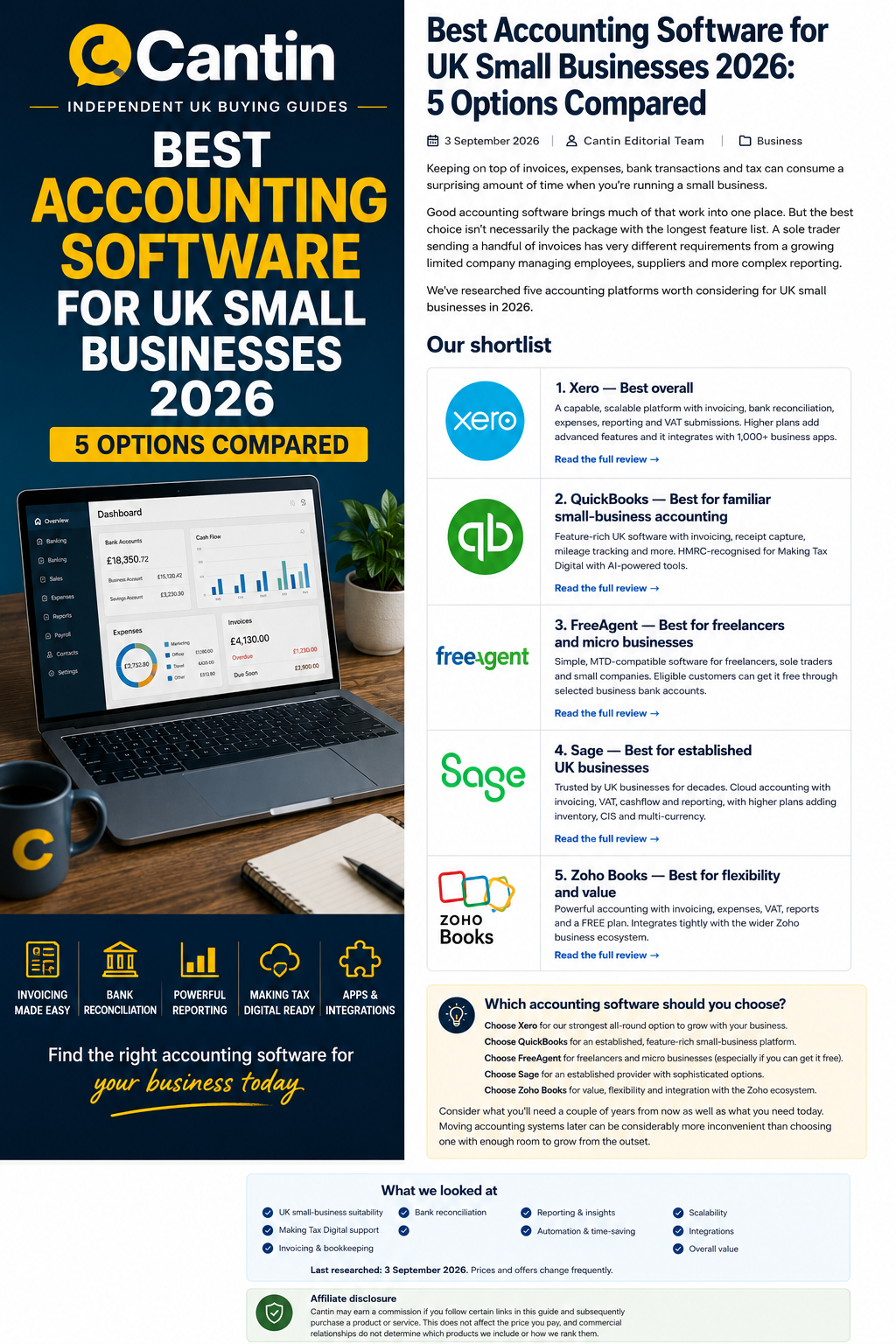
Keeping on top of invoices, expenses, bank transactions and tax can consume a surprising amount of time when you're running a small business.
Good accounting software brings much of that work into one place. But the best choice isn't necessarily the package with the longest feature list. A sole trader sending a handful of invoices has very different requirements from a growing limited company managing employees, suppliers and more complex reporting.
For this guide, Cantin has researched five accounting platforms worth considering for UK small businesses in 2026: Xero, QuickBooks, FreeAgent, Sage and Zoho Books.
Important: Cantin has researched the current products, features and publicly available information used in this guide. We have not carried out a long-term controlled implementation of every accounting platform listed, so our recommendations are based on product capabilities and likely suitability for UK small businesses.
Our accounting software shortlist
| Software | Our pick for | Best suited to |
|---|---|---|
| Xero | Best overall | Small businesses wanting a capable system with room to grow |
| QuickBooks | Best established alternative | Businesses wanting familiar small-business accounting tools |
| FreeAgent | Best for freelancers and micro businesses | Sole traders and small companies, especially with eligible bank accounts |
| Sage | Best traditional UK accounting option | Businesses wanting an established provider with scalable features |
| Zoho Books | Best for flexibility and value | Businesses wanting strong value or integration with other Zoho products |
Accounting software features, prices and promotional offers can change. Always check the provider's current plan details before subscribing.
1. Xero — our best overall pick
Xero is the first platform we'd look at for many UK small businesses that want accounting software capable of supporting them beyond the earliest stages of the company.
Its UK software covers invoicing, bank reconciliation, expenses, reporting and VAT submissions, while its plans support Making Tax Digital requirements.
Xero also has a particularly large integration ecosystem, allowing businesses to connect accounting with ecommerce, CRM, payroll, payments, inventory and many other business systems.
Why we'd consider it
- Strong all-round small-business accounting platform.
- Invoicing and payment tracking.
- Bank reconciliation.
- Expense management.
- VAT and Making Tax Digital support.
- Financial reporting.
- Large ecosystem of third-party integrations.
- Suitable for businesses expecting their accounting requirements to grow.
Best suited to: a small or growing company that wants a mainstream accounting platform with plenty of integrations and scope to expand.
Things to consider: a very small business with only basic invoicing and bookkeeping needs may not require everything Xero provides. Compare the plan features carefully before paying for functionality you won't use.
2. QuickBooks — our established alternative
QuickBooks is another major accounting name and remains a strong alternative to Xero for UK sole traders and small businesses.
Current UK products include invoicing, receipt capture, mileage tracking and transaction categorisation, alongside Making Tax Digital functionality.
QuickBooks has also been adding more automation and AI-assisted features designed to reduce the amount of routine bookkeeping work required.
Why we'd consider it
- Well-established small-business accounting platform.
- Invoicing and payment management.
- Receipt capture.
- Mileage tracking.
- Transaction categorisation.
- Making Tax Digital support.
- Automation across routine accounting tasks.
Best suited to: small businesses wanting an established accounting platform with a broad range of everyday bookkeeping tools.
Things to consider: QuickBooks offers several plan levels, so check exactly which features are included in the subscription you're considering rather than choosing solely on introductory pricing.
3. FreeAgent — our freelancer and micro-business pick
FreeAgent is particularly interesting for freelancers, sole traders and very small companies.
Its core platform handles invoicing, expenses, banking, tax and general business administration, while also supporting Making Tax Digital.
One of FreeAgent's biggest advantages is that some UK business banking customers can receive the full software free through an eligible business account.
Why we'd consider it
- Designed with smaller businesses and freelancers in mind.
- Invoicing and expenses.
- Banking and reconciliation.
- Tax management.
- Making Tax Digital compatibility.
- Potentially available free through eligible UK business bank accounts.
Best suited to: freelancers, sole traders and micro businesses, particularly where an eligible bank account makes FreeAgent available without a separate subscription.
Things to consider: businesses expecting to become substantially more complex may prefer the broader ecosystems surrounding Xero, QuickBooks, Sage or Zoho.
4. Sage — our established UK accounting pick
Sage has been associated with UK business accounting for decades, but its current cloud accounting products are considerably different from the older desktop systems many business owners may remember.
Current Sage accounting products cover invoicing, cashflow, VAT, bank reconciliation and reporting, with higher plans adding capabilities such as supplier management, CIS, inventory and multi-currency support.
Sage also offers automation and productivity features designed to reduce repetitive accounting work.
Why we'd consider it
- Established UK accounting brand.
- Invoicing and cashflow management.
- Bank reconciliation.
- VAT and Making Tax Digital support.
- Financial reporting.
- Higher-tier support for inventory and multi-currency requirements.
- Good range of options for increasingly complex businesses.
Best suited to: businesses wanting an established provider with accounting options that can scale into more sophisticated requirements.
Things to consider: compare Sage's plan levels carefully. Some of the more advanced features sit higher up the subscription range and may be unnecessary for a straightforward small business.
5. Zoho Books — our flexibility and value pick
Zoho Books is perhaps the most interesting alternative in this shortlist, particularly for businesses already using — or considering — other Zoho products.
The UK version covers invoicing, expenses, bank reconciliation, VAT returns and a broad range of financial reports. Zoho Books also supports Making Tax Digital for VAT and relevant UK tax workflows.
Zoho currently offers a free accounting plan, while paid plans progressively add more functionality for growing businesses.
The broader Zoho ecosystem is another important advantage. A business using Zoho CRM, Zoho Books and other Zoho applications can potentially keep a significant amount of its software under one provider.
Why we'd consider it
- Free entry-level accounting option.
- Invoicing and expense management.
- Bank reconciliation.
- VAT and Making Tax Digital support.
- Recurring invoices.
- Financial reporting.
- Good integration with the wider Zoho ecosystem.
- Strong value proposition for small businesses.
Best suited to: value-conscious small businesses or companies that want their accounting software to integrate closely with CRM and other business tools.
Things to consider: the large number of Zoho applications can initially make the wider ecosystem look more complex than necessary. A small business should start with the products it actually needs rather than trying to adopt everything at once.
Which accounting software would we choose?
There isn't one accounting platform that is right for every small business.
Our starting shortlist would be:
- Xero for the strongest all-round proposition.
- QuickBooks for an established mainstream alternative.
- FreeAgent for freelancers, sole traders and micro businesses.
- Sage for businesses wanting an established UK accounting provider.
- Zoho Books for value, flexibility and integration with other Zoho software.
If we were setting up accounting software for a typical growing UK small business today, we'd probably compare Xero, QuickBooks and Zoho Books first.
What should a small business look for in accounting software?
Making Tax Digital support
For a UK business, tax compliance is an obvious starting point.
Check that the software supports the Making Tax Digital requirements relevant to your business and that the particular plan you are considering includes the functionality you need.
Bank feeds and reconciliation
Connecting your business bank account can dramatically reduce manual bookkeeping.
Transactions can be imported automatically and matched against invoices, expenses and other accounting records.
The easier the reconciliation process is, the more likely your accounting records are to remain current rather than becoming a job that gets postponed until the end of the month.
Invoicing
For many small businesses, invoicing is the part of accounting software they use most frequently.
Useful features can include:
- Recurring invoices.
- Automatic payment reminders.
- Online payment options.
- Quote-to-invoice conversion.
- Invoice status tracking.
Expenses and receipt capture
Software that allows receipts to be photographed or uploaded can make expense management much easier than collecting paper receipts in a drawer.
Check whether receipt capture is included in the plan you're considering and whether there are usage limits.
Your accountant
If you already work with an accountant or bookkeeper, ask what platforms they support.
Using a system your accountant knows well can make collaboration much easier and may reduce the amount of manual work required at year end.
Reporting
Accounting software shouldn't just exist for tax returns.
Useful reporting can help answer questions such as:
- How profitable is the business?
- How much money are customers currently owing us?
- What are our largest expense categories?
- How is cashflow changing?
- Which months are strongest or weakest?
Those answers can be considerably more valuable than simply knowing whether the books balance.
Integrations
Think about the other software your business uses.
Connecting accounting with CRM, ecommerce, inventory, payroll and payment platforms can reduce duplicated data entry and make the accounting system much more useful.
Free accounting software vs paid accounting software
Free software can be perfectly adequate for a small business with straightforward needs.
Zoho Books currently provides a free entry-level plan, while FreeAgent can be available without a separate subscription through eligible UK banking arrangements.
The reason to move onto paid software is usually because the business needs additional automation, more users, advanced reporting, inventory management, multi-currency support or other functionality beyond basic bookkeeping.
Don't assume paid automatically means better for your particular business.
Do sole traders need accounting software?
Not necessarily, but it can make administration considerably easier.
A sole trader with relatively few transactions may be able to manage records using simpler methods. But as invoice volume, expenses and tax requirements increase, accounting software can save time and reduce the risk of losing track of important information.
Making Tax Digital requirements also make suitable digital record keeping increasingly important for UK businesses.
Should you choose the accounting software your accountant recommends?
Your accountant's preference is worth considering, but it shouldn't be the only factor.
An accountant who works with a particular platform every day may be able to support you much more efficiently on that system.
However, you and your employees will probably use the software more frequently than the accountant does. Make sure it also works well for the people actually raising invoices, recording expenses and managing the business.
Can you change accounting software later?
Yes, although it can involve more work than switching many other types of software.
Historical transactions, customer and supplier information, opening balances and tax records may all need to be transferred or retained appropriately.
That's why it makes sense to think about where your business may be in two or three years rather than simply choosing the cheapest option today.
How Cantin chose these accounting platforms
For this guide we considered areas including:
- Suitability for UK small businesses.
- Making Tax Digital support.
- Invoicing.
- Expenses and receipt management.
- Bank reconciliation.
- Financial reporting.
- Automation.
- Integrations.
- Scalability.
- Overall value.
We have deliberately avoided ranking products according to which companies offer Cantin the highest affiliate commission.
Products can be included in our guides regardless of whether Cantin has a commercial relationship with the provider.
Frequently asked questions
What is the best accounting software for a UK small business?
There is no universal answer, but Xero, QuickBooks, FreeAgent, Sage and Zoho Books are all worth considering. Xero is our strongest overall pick, while FreeAgent is particularly interesting for smaller businesses and Zoho Books offers strong value.
What is the best accounting software for a sole trader?
FreeAgent and Zoho Books are particularly worth considering for sole traders because both have propositions aimed at smaller businesses and can potentially be used at very low cost.
Does accounting software replace an accountant?
Not necessarily. Accounting software helps record and organise financial information, while an accountant can provide professional advice, tax planning and other services. Many businesses use both.
Can my accountant access my accounting software?
Most mainstream cloud accounting platforms provide ways to give accountants or bookkeepers access to the business records. Check the user and adviser access rules for the product you're considering.
Is cloud accounting software safe?
Major accounting providers use security measures designed to protect customer data, but businesses still need sensible account security. Use strong unique passwords, enable multi-factor authentication where available and control who has access to financial information.
Should I choose accounting software based on the introductory price?
No. Introductory discounts can be attractive, but compare the normal renewal price and the plan features you'll require over the longer term.
The Cantin verdict
If we were choosing accounting software for a typical growing UK small business today, Xero would be the first platform we'd investigate.
We'd compare it closely with QuickBooks, while Zoho Books deserves particular attention for businesses looking for strong value or already considering the wider Zoho ecosystem.
For freelancers and micro businesses, FreeAgent can be particularly compelling — especially where an eligible business bank account makes it available without a separate subscription.
Sage remains a strong option for businesses that value an established UK accounting provider and may require increasingly sophisticated features as they grow.
The right accounting software should ultimately reduce administration, make the finances easier to understand and give you a clearer picture of how the business is performing.
Last researched: 3 September 2026. Product features, plan limits, tax functionality and prices can change. Cantin recommends checking current information with the provider before subscribing.