Ninja vs Cosori Air Fryers UK 2026: Which Should You Buy?
Ninja and Cosori take very different approaches to air frying. We compare the Ninja Foodi MAX Dual Zone 9.5L and Cosori TurboBlaze 6L to help you decide which design better suits your kitchen and the way you cook.
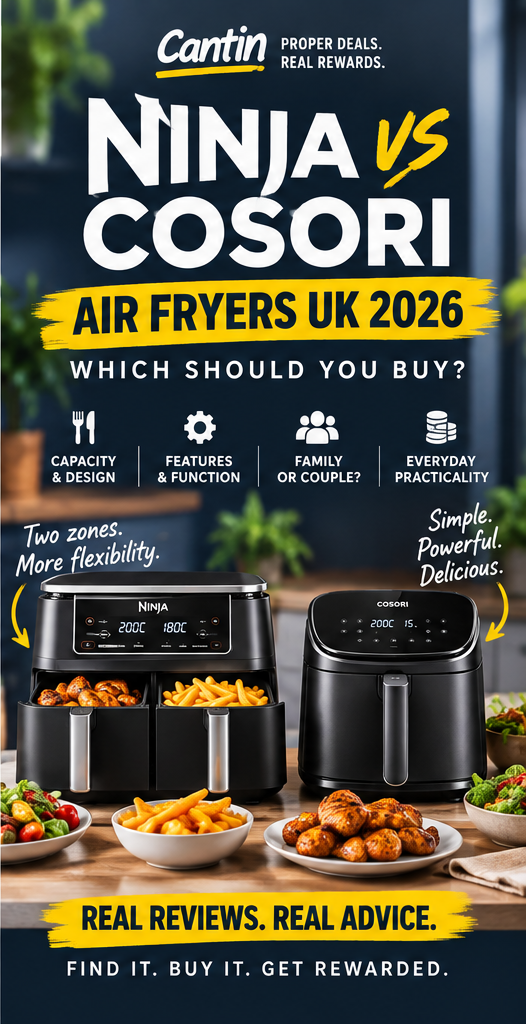
Ninja and Cosori are two of the most recognisable names in the UK air-fryer market, but choosing between them isn't simply a matter of deciding which brand is "best".
Their popular machines can be quite different.
For this comparison, we've focused on the Ninja Foodi MAX Dual Zone AF400UK and the Cosori TurboBlaze 6L. The Ninja gives you two independent cooking drawers with a combined 9.5L capacity, while the Cosori uses one uninterrupted 6L basket.
That difference affects almost everything from the types of meals they're best suited to, to how much worktop space they occupy and how much washing-up you'll have afterwards.
Cantin has compared the manufacturers' current UK specifications and features to work out which type of cook each machine is likely to suit.
Quick verdict
Choose the Ninja Foodi MAX Dual Zone if: you regularly want to cook two different foods at different temperatures or for different lengths of time, particularly when preparing family meals.
Choose the Cosori TurboBlaze if: you'd rather have one good-sized basket, a less complicated cooking arrangement and a machine better suited to preparing one main dish or batch at a time.
Our verdict: there isn't a universal winner here.
The Ninja is our pick for cooking flexibility, while the Cosori is our pick for single-basket simplicity.
For a family regularly cooking things such as chicken and chips together, we'd lean towards the Ninja. For couples, smaller households and people who generally cook one type of food at a time, we'd seriously consider the Cosori.
Ninja vs Cosori at a glance
| Ninja Foodi MAX Dual Zone AF400UK | Cosori TurboBlaze 6L | |
|---|---|---|
| Capacity | 9.5L total | 6L |
| Basket design | 2 independent drawers | 1 basket |
| Cooking functions | 6 | 9 |
| Temperature | Variable; Max Crisp reaches 240°C | 30–230°C |
| Independent cooking zones | Yes | No |
| Synchronised finishing | Yes — SYNC | Not applicable |
| Copy settings between zones | Yes — MATCH | Not applicable |
| Dishwasher-safe parts | Yes | Yes |
| Manufacturer guarantee / warranty | 2 years on registration | 2 years |
| Best suited to | Multi-part meals & families | Single-basket cooking & batches |
1. Basket design: the biggest difference
This is arguably more important than either brand name.
The Ninja AF400UK has two separate cooking drawers. Its 9.5L capacity is therefore divided between two zones rather than being one enormous 9.5L space.
Each drawer can be controlled independently.
That means you could cook chicken in one side while cooking chips in the other, using different temperatures and cooking times.
Ninja's SYNC feature coordinates the two zones so foods requiring different cooking times can finish together. MATCH copies the settings from one zone to the other when you're cooking larger quantities of the same thing.
The Cosori takes the opposite approach.
Its 6L capacity is one uninterrupted basket.
You lose the ability to cook two foods independently, but gain a single cooking space that can be more convenient for larger individual items or one big batch.
There's no objectively better arrangement — it depends on what you're cooking.
Winner for two-part meals: Ninja
Winner for straightforward single-basket cooking: Cosori
2. Capacity
On the numbers alone, Ninja wins easily: 9.5L versus 6L.
Ninja says its AF400UK can accommodate a 2kg chicken in each drawer and describes it as suitable for feeding larger households.
Cosori describes the TurboBlaze's 6L basket as suitable for around three to six people.
We wouldn't take either serving estimate too literally. How many people an air fryer feeds depends enormously on what you're cooking.
More importantly, total litres don't tell the whole story.
A large item must fit inside one of the Ninja's individual drawers. Cosori's entire 6L volume is available as one cooking area.
For several different foods, Ninja's arrangement has the advantage. For one larger batch, the Cosori layout can be more convenient than its lower headline capacity suggests.
Winner for total capacity: Ninja
3. Cooking flexibility
Ninja provides six cooking modes, but its real strength isn't the number of presets — it's the ability to run two different cooking programmes simultaneously.
You can have different temperatures, times or even functions operating in each drawer, with SYNC coordinating the finish.
Cosori provides nine functions, including Air Fry, Roast, Grill, Frozen, Reheat, Preheat, Proof, Bake, Dehydrate and Keep Warm. Its five-speed fan varies according to cooking function, and its temperature range extends from 30°C to 230°C.
So this one's interesting.
Cosori offers more individual cooking modes. Ninja offers greater simultaneous cooking flexibility.
For most households, we think the ability to cook two genuinely different foods independently is the bigger practical advantage.
Winner: Ninja
4. Which is better for family meals?
For meals made up of multiple components, the Ninja makes a strong case for itself.
Imagine cooking:
- Chicken and chips.
- Salmon and vegetables.
- Sausages and roast potatoes.
- Children's food alongside an adult meal.
The two-zone arrangement lets you treat those foods separately.
With the Cosori, you're working with one cooking environment. You can still prepare excellent family-sized batches, but foods needing significantly different times or temperatures may need to be cooked sequentially or coordinated manually.
On the other hand, a household that predominantly uses an air fryer for one component — perhaps chips, chicken, vegetables or reheating food — may get little benefit from having two independent drawers.
Winner for multi-component family meals: Ninja
5. Which is better for couples and smaller households?
This is where the Cosori starts fighting back.
A 9.5L dual-zone machine is substantial, and not everybody needs that capacity.
Cosori's 6L basket provides plenty of usable space while keeping everything in one cooking zone.
For a smaller kitchen or household that doesn't need dual-zone cooking every day, Cosori's simpler format makes a lot of sense.
Winner: Cosori
6. Cleaning
Both manufacturers specify dishwasher-safe removable components.
The difference is quantity.
With Cosori, you've essentially got one basket and its removable components to deal with.
With Ninja, there are two drawers and two crisper plates.
Dishwasher owners may barely care. If you're washing everything by hand, the Cosori has the obvious advantage of fewer separate cooking containers.
Winner: Cosori
7. Chips and frozen food
Both machines are designed for exactly this sort of job.
Ninja's Max Crisp mode is specifically designed for high-temperature crisping and reaches a preset 240°C on the AF400UK.
Cosori's TurboBlaze operates up to 230°C and uses its variable-speed fan system to control airflow for different cooking functions.
Without conducting controlled side-by-side food testing ourselves, we don't think it's responsible to declare that one produces objectively crispier chips.
What we can say is that Ninja gives you the option of cooking chips in one drawer while something completely different cooks in the other.
For many buyers, that's more useful than a theoretical difference in crispness.
Verdict: Tie for straightforward air frying; Ninja has the flexibility advantage.
8. Chicken, meat and larger items
This is another situation where basket shape matters.
Ninja says each AF400UK drawer can fit up to a 2kg chicken, which is impressive for a dual-drawer design.
Cosori's uninterrupted 6L basket means you don't have a divider between cooking zones, which may make it more convenient for some single larger items.
If you're cooking a roast-style meal with meat in one zone and vegetables or potatoes in another, Ninja is particularly appealing.
If you're primarily cooking one joint, chicken or batch at a time, the simplicity of the Cosori may be preferable.
Verdict: Depends on how you cook.
9. Worktop space
Don't overlook this.
The Ninja is a sizeable appliance. Its dual-drawer layout and 9.5L capacity inevitably require more physical space.
The Cosori's 6L design is narrower and simpler in layout.
If your air fryer will permanently live on a generous kitchen worktop, this may not matter.
If you're already negotiating territory between a kettle, toaster, coffee machine and microwave, it absolutely will.
Winner: Cosori
10. Energy use and running costs
Both manufacturers make energy-saving claims compared with conventional ovens, but the claims are based on their own testing methodologies and aren't directly comparable.
We therefore wouldn't say one is categorically "cheaper to run" based solely on those percentages.
There is also a basic practical consideration: you only use the capacity you need.
Ninja allows a single zone to be operated independently, so owning a two-drawer model doesn't mean both drawers must always be running.
The real cost of cooking depends on temperature, duration, food quantity, function and how much of the appliance you're using.
Verdict: No meaningful winner without controlled like-for-like testing.
11. Price and value
Prices for both machines change with retailer promotions, so we're deliberately not basing our recommendation on a temporary sale price.
Instead, ask what you're paying for.
With the Ninja, a large part of the value is capacity and two-zone flexibility.
With the Cosori, the appeal is a capable 6L single-basket machine with a wide temperature range and multiple cooking functions.
If you regularly use both Ninja drawers, the extra capability may easily justify spending more.
If you'd rarely cook two different things simultaneously, paying for a large dual-zone machine could simply mean sacrificing more worktop space for functionality you don't use.
Winner: Depends on your cooking habits.
Ninja vs Cosori: which should you buy?
Buy the Ninja Foodi MAX Dual Zone if...
You regularly cook meals containing two different components.
It's particularly well suited to families, batch cooking and households where coordinating different foods is a regular annoyance.
The combination of two independent drawers, SYNC and MATCH is genuinely useful rather than merely another collection of presets.
Cantin verdict: Best for cooking flexibility and family meals.
Buy the Cosori TurboBlaze 6L if...
You normally cook one main food or batch at a time and would prefer one straightforward basket.
Its 6L capacity, nine cooking functions, wide temperature range and simpler single-basket design make it a strong alternative to the increasingly enormous multi-zone machines appearing on kitchen worktops.
Cantin verdict: Best for single-basket simplicity.
Our overall winner
We're calling this one a draw — but for a good reason.
If we simply compared capacity and simultaneous cooking ability, Ninja wins.
But that doesn't make it the better purchase for everybody.
A couple using an air fryer mainly for chicken, vegetables, chips or reheating food could buy a huge dual-zone machine and barely use its defining feature.
Likewise, a family regularly trying to get chicken, chips and vegetables ready together could buy a single-basket Cosori and quickly wish they'd chosen independent cooking zones.
So our recommendation is:
- Best for families & multi-part meals: Ninja Foodi MAX Dual Zone
- Best for couples, smaller kitchens & single-basket cooking: Cosori TurboBlaze 6L
That's more useful, we think, than manufacturing an overall winner where one doesn't really exist.
What about other Ninja and Cosori air fryers?
Neither brand is limited to these two machines.
Ninja currently sells several Dual Zone models in the UK, including 7.6L and 9.5L configurations.
Cosori's UK range stretches from compact models through conventional dual-basket machines to larger TwinFry and Turbo Tower designs.
That means the distinction between "Ninja = dual basket" and "Cosori = single basket" isn't true across the brands as a whole.
We've deliberately compared these two particular products because they represent two popular but fundamentally different approaches.
If you already know you want two cooking zones, compare dual-zone models from both manufacturers rather than choosing purely by brand.
Frequently asked questions
Is Ninja better than Cosori?
Not universally. Ninja's Foodi MAX Dual Zone is more flexible when cooking two different foods simultaneously. Cosori's TurboBlaze offers a simpler single-basket arrangement that may be preferable for smaller households and people who normally cook one food at a time.
Is a dual-basket air fryer better than a single basket?
It depends on what you cook. Two baskets are useful for foods requiring different temperatures or cooking times. One larger uninterrupted basket can be more convenient for larger individual items and creates fewer separate components to clean.
Can I use only one drawer on the Ninja?
Yes. The AF400UK can operate a single cooking zone independently; you don't have to run both drawers.
Does the Cosori TurboBlaze have two cooking zones?
No. The TurboBlaze 6L is a single-basket air fryer. Cosori does, however, sell other UK models with dual-zone arrangements.
Which is easier to clean?
Both have dishwasher-safe components, but the Cosori has fewer separate cooking containers because it uses one basket rather than two.
Which is better for a family?
For a family regularly preparing several components of a meal simultaneously, we'd choose the Ninja. For a smaller household predominantly cooking one dish or batch at a time, we'd lean towards the Cosori.
How Cantin researched this comparison
Cantin researched this guide using current UK manufacturer product information, specifications and operating instructions from Ninja and Cosori.
We compared capacity, basket configuration, cooking functions, temperature controls, dimensions, cleaning requirements and the practical differences between single- and dual-zone cooking.
Cantin has not conducted controlled laboratory testing of these two machines, so we have deliberately avoided making unsupported claims about taste, crispness, cooking speed or electricity consumption.
Product ranges, availability, specifications and prices can change, so check the manufacturer's current information before purchasing.
Last researched: 8 September 2026.
Affiliate disclosure
Cantin may earn a commission if you purchase through some links in this guide. Cosori is currently an affiliate partner of Cantin. Affiliate relationships do not determine our editorial rankings or recommendations. Where a Cantin Reward is offered, eligibility and validation conditions apply.